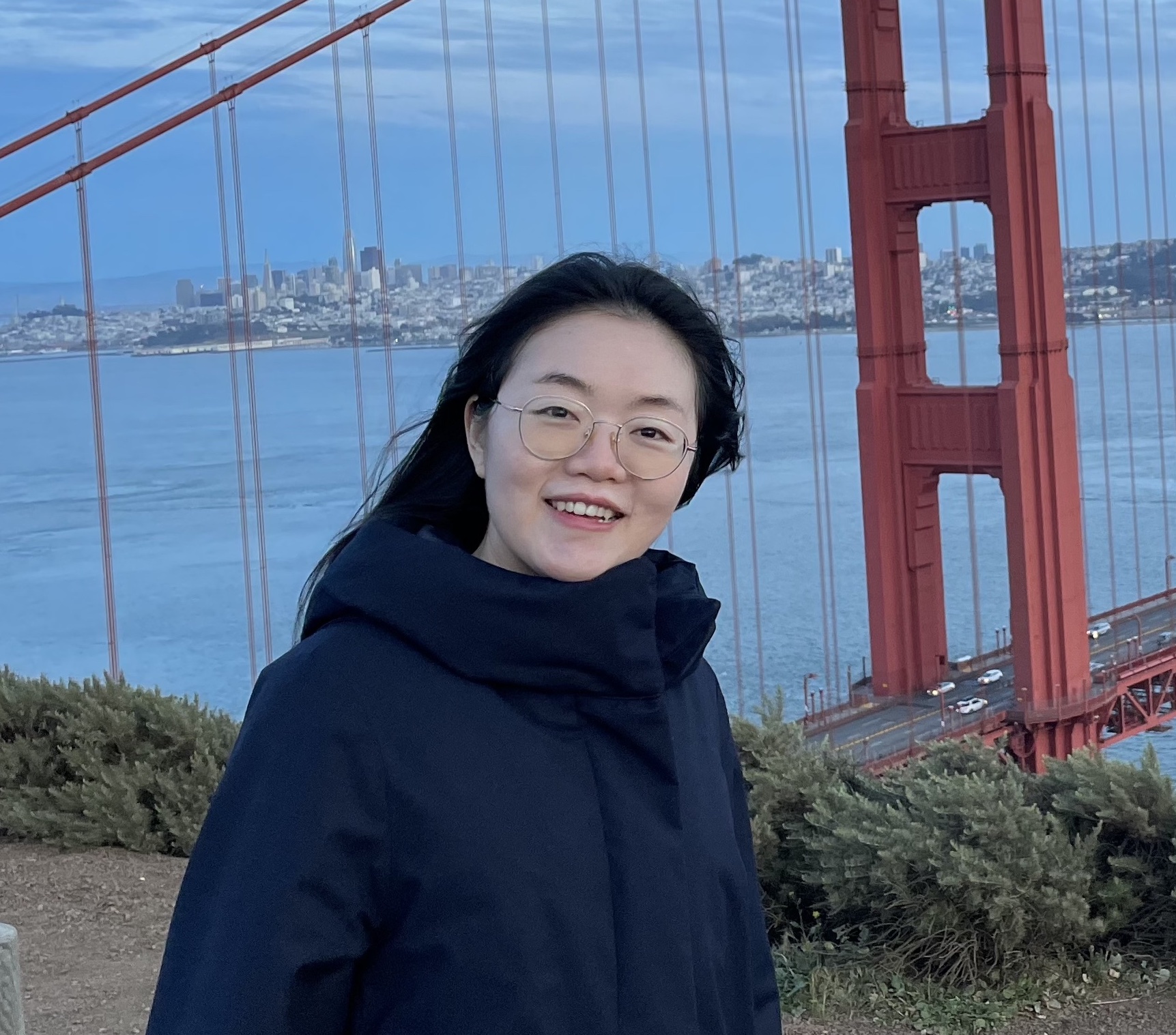
Hello, I'm Jingyuan Li
Research Scientist, Large Language Models · Applied Scientist @ Amazon AGI
Research Scientist, Large Language Models · Applied Scientist @ Amazon AGI
I am a research scientist working on large language models. At Amazon AGI I develop foundation models end to end — large-scale pretraining, supervised fine-tuning, and reinforcement learning — including trillion-token multimodal pretraining runs on multi-thousand-GPU clusters and GRPO-based post-training for reasoning.
I completed my Ph.D. at the NeuroAI Lab, University of Washington, Seattle, advised by Prof. Eli Shlizerman, and hold an M.S. from Carnegie Mellon University, where I worked with Prof. Tai Sing Lee. I have also spent time at Microsoft Research Asia and Google X.
My work centers on how large models learn from sequential data and how their behavior can be shaped after pretraining. Current topics include Pretraining at Scale, Post-training (SFT, RLHF/GRPO, Reward Design), Multimodal and Agentic LLMs, Representation Learning, and Evaluation, Robustness and Uncertainty.
Authors: Jiajun Fan, Roger Ren, Jingyuan Li, Rahul Pandey, Prashanth Gurunath Shivakumar, Ivan Bulyko, Ankur Gandhe, Ge Liu, Yile Gu.
ICLR 2026
A GRPO-based reinforcement learning framework with a multi-dimensional process-reward suite. It removes "test-time inverse scaling," turning longer chain-of-thought reasoning from a liability into a consistent gain, and reaches state-of-the-art results on MMAU Test-mini with near-human performance on MMSU reasoning tasks.
Keywords: Reinforcement Learning, GRPO, Process Rewards, LLM Reasoning
Authors: Mingfei Chen, Zijun Cui, Xiulong Liu, Jinlin Xiang, Caleb Zheng, Jingyuan Li, Eli Shlizerman.
NeurIPS 2025
A benchmark and modeling study of spatial reasoning in audio-visual LLMs, measuring how multimodal models build spatial understanding from combined sight and sound.
Keywords: Multimodal LLM, Audio-Visual Reasoning, Benchmarking
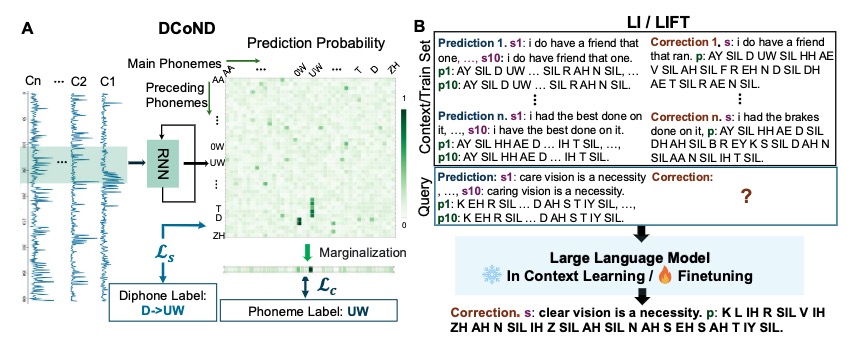
Authors: Jingyuan Li, Trung Le, Chaofei Fan, Mingfei Chen, Eli Shlizerman.
Journal of Neural Engineering, 2025
DCoND-LIFT decodes high-dimensional neural time series into context-dependent token sequences and rescores candidates with large language models, reducing word error rate from 8.93% to 5.77% and winning first place in the Brain-to-Text Benchmark '24 competition.
Keywords: Large Language Model, Sequence Decoding, Brain-Computer Interface
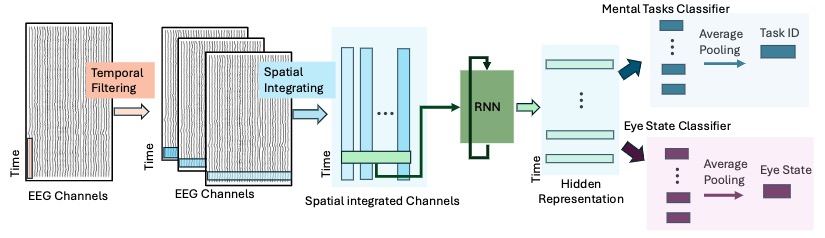
Authors: Jingyuan Li, Yansen Wang, Nie Lin, Dongsheng Li.
ICASSP 2025
Preprint
A task paradigm and spatiotemporal sequence model that map wearable sensor time series to 35 characters, improving accuracy over direct character imagination by around 8.5%.
Keywords: Sequence Modeling, Codebook Learning, Time-Series Decoding, GRU, CNN
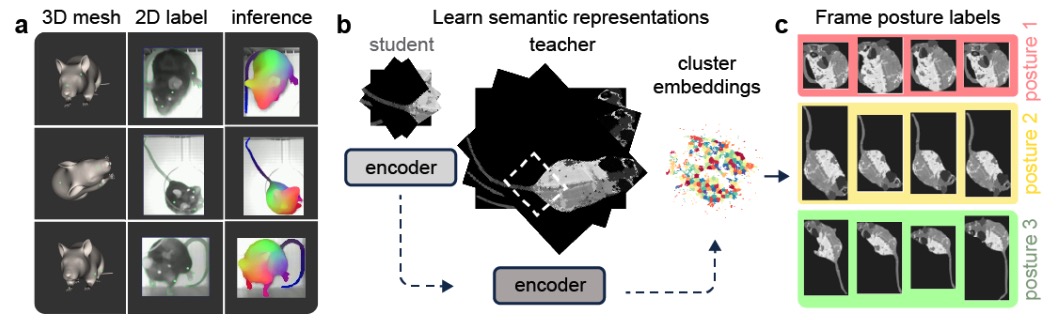
Authors: Ying Yu*, Jingyuan Li*, Kun Su, Anna Bowen, Carlos Campos. *Equal contribution.
Cosyne 2024 Oral
Talk
A self-supervised approach that maps 2D to 3D posture, from which behavior segments can be retrieved from a single example.
Keywords: Posture modeling, Behavior segmentation
Authors: Jingyuan Li, Leo Scholl, Trung Le, Pavithra Rajeswaran, Amy Orsborn, Eli Shlizerman.
NeurIPS 2023
Paper
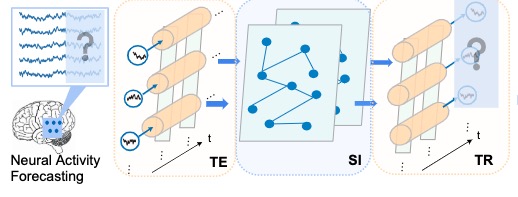
A graph neural network for forecasting high-dimensional time series that also recovers the underlying dependency structure between channels.
Keywords: Graph Neural Networks, Time-Series Forecasting, Representation Learning
Authors: Jingyuan Li, Trung Le, Eli Shlizerman.
IEEE TNNLS, 2023
Paper
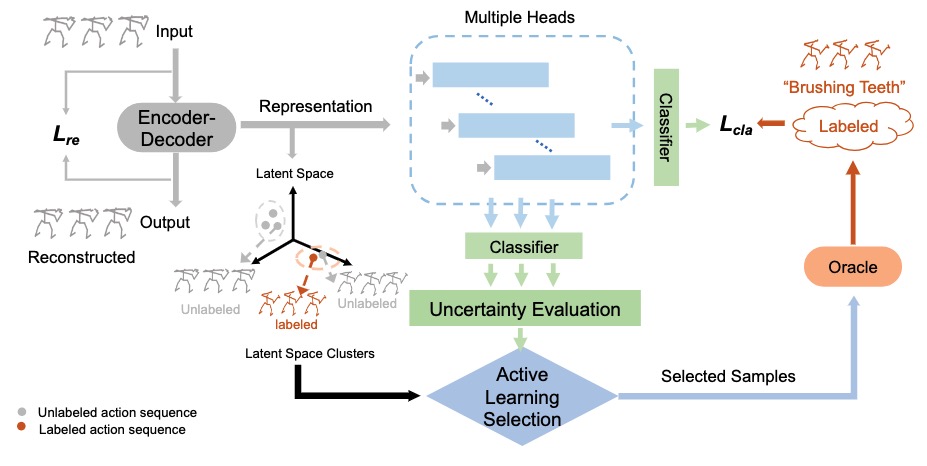
An active learning method for semi-supervised sequence recognition that reaches strong performance when only a limited number of annotated samples is available.
Keywords: Active Learning, Semi-supervised Learning, Data Efficiency
Authors: Jingyuan Li, Moishe Keselman, Eli Shlizerman.
Frontiers in Systems Neuroscience, 2025
Preprint
GitHub
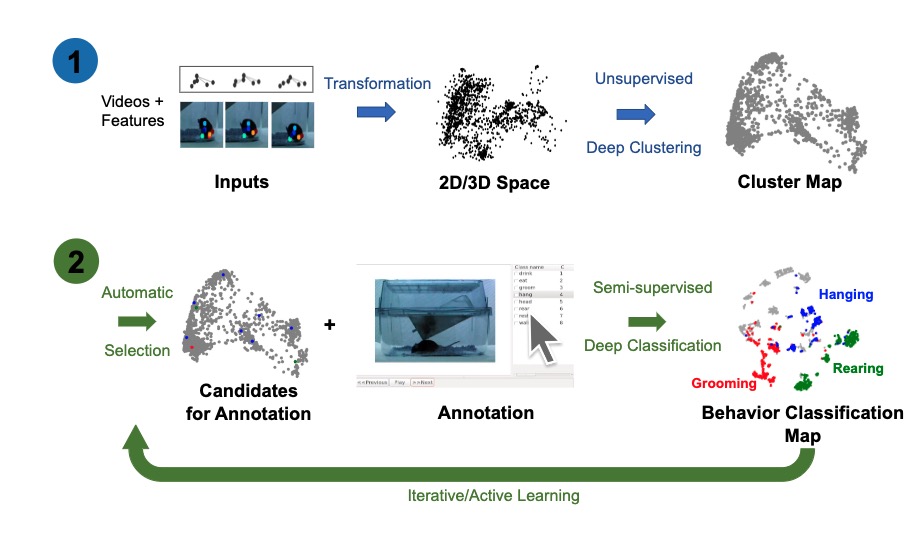
An active learning pipeline that recognizes behavior from a small number of labeled examples, released with a GUI for general use.
Keywords: Active Learning, Clustering, Open-Source Tooling
Full publication list on Google Scholar, including work at ICLR 2026 (inner-speech decoding, EgoBrain), NeurIPS 2025 (SpINT), and IEEE TNNLS.